
In securities investing, choosing a suitable analytical method plays a decisive role in long-term performance. The two most common approaches today are Top-Down and Bottom-Up, and each offers its own perspective on the market and investment opportunities.
Quick summary
- Top-Down analysis is a method that moves from the macroeconomic picture to the industry, the company and finally the stock
- Bottom-Up analysis is a method that starts from a specific company, then expands to the industry and the related macro factors
- The method suited to each type of investor
Top-Down suits investors who want to observe market trends and find opportunities by sector
Bottom-Up suits investors who want to focus on corporate value and hold over the medium and long term
- The common objective of both methods is to support the selection of stocks that match the investment strategy
1. Definition
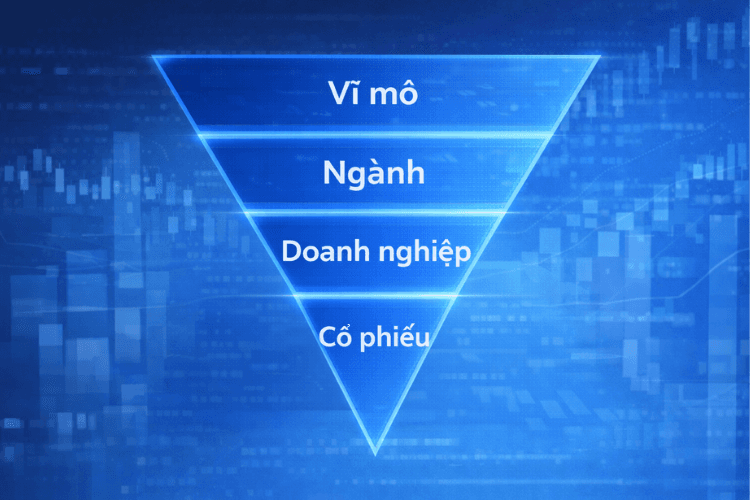
Top-Down
This is a method of analysing from the whole to the detail: starting from the macroeconomy, then the industry and finally the company/stock.
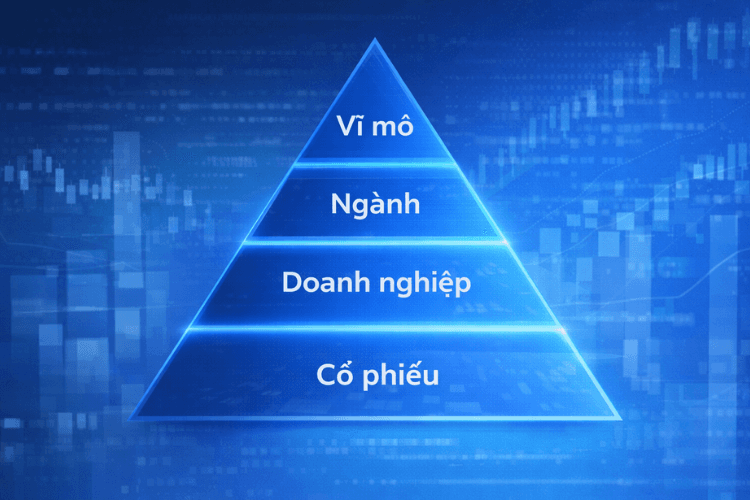
Bottom-Up
Conversely, this method focuses first on each specific company, and only then expands to the industry and macro factors.
2. Classification & characteristics
2.1 The Top-Down method
a) Approach
- Macro analysis
- Industry analysis
- Company analysis
- Combining technical analysis to find entry points
b) Details
- Macro analysis:
Assessing GDP, inflation, interest rates, State policy, social trends - Industry analysis:
Examining supply - demand, competition, growth prospects - Company analysis:
Assessing business operations, competitive advantages, risks - Technical analysis:
Identifying price trends and stock entry points
2.2 The Bottom-Up method
a) Approach
- Start from a potential stock
- Analyse the company
- Expand to the industry
- Finally, consider macro factors
b) Key characteristics
- Focuses on the company's intrinsic value
- Prioritises companies with strong fundamentals
- Less affected by short-term market fluctuations
c) Suitable for
- Long-term investors
- Those capable of in-depth company analysis
3. How to identify & apply
When to use Top-Down
- The market experiences large swings driven by macro factors
- You want to determine "where the money flow is"
- Investing along industry cycles
When to use Bottom-Up
- Looking for long-term growth stocks
- The market moves sideways or becomes differentiated
- You are capable of analysing companies
How to combine them effectively
| Top-Down | Bottom-Up |
| Select the industry | Stock |
| Combine technical analysis to optimise the entry point | |
4. Common mistakes
- Using only Top-Down while ignoring company quality
- Using only Bottom-Up without paying attention to macro trends
- Suffering "information overload" when analysing too many factors
- Personal bias making assessments less objective
- Lack of consistency in the investment method
Top-Down and Bottom-Up are not opposites but complement each other. Understanding and flexibly applying both methods will help raise the probability of investment success, especially during periods of strong market volatility and differentiation.
(!) This article is for informational purposes only and is not investment advice. Readers should do their own research or consult a professional before making financial decisions