
What is business valuation using the FCFE and FCFF models?

The FCFE (Free Cash Flow to Equity) model is a business valuation method based on the free cash flow available to shareholders, helping determine the intrinsic value of a stock.
Intro
Not every company pays dividends regularly enough for the DDM to be applied. In those cases, FCFE is a more suitable method because it focuses on the actual cash flow that shareholders can receive. This approach is closer to the financial substance of a business, especially for growing companies.
Quick summary
- FCFE is the cash flow left for shareholders after deducting investments and debt obligations
- FCFF is the cash flow for the entire firm (both creditors and shareholders)
- FCFE is discounted at Ke, FCFF is discounted at WACC
- FCFE is suitable for valuation from the shareholder's perspective, FCFF is suitable for valuing the firm as a whole
- Value is determined by discounting future cash flows (the Gordon growth model may be used)
1. What is FCFF?
Free cash flow is the cash flow generated from business operations that belongs to creditors
and the owners of the business, after deducting expenses and investments for future
operations (purchasing additional equipment, expanding plants, etc.).

1.1 FCFF formula
FCFF = Cash flow from operations + [Interest expense x (1 - Corporate income tax (CIT)] – Capital expenditure
Where:
- Cash flow from business operations = profit after tax + depreciation - change in working capital
- Interest expense is presented in the income statement
- The current CIT rate in Vietnam in 2023 is 20% (applicable to ordinary enterprises)
- Capital expenditure (CAPEX) is an item in the cash flow statement, specifically the item "cash paid for purchases and construction of fixed assets"
1.2. The meaning of free cash flow to the firm (FCFF)
It helps investors determine the value of a business through the discounted cash flow method.
Determining FCFF also helps a business adjust its financial policies appropriately:
- FCFF < 0
This shows that the cash flow generated from operations is not enough to serve investment activities. Therefore,
the business needs to raise additional new capital (debt or equity) or cut back on its investments.
- FCFF > 0
This shows that the cash flow generated is sufficient for investment with a surplus remaining. Accordingly, the business can repay
debt, raise its dividend payout, or carry out share buybacks.
1.3 Applying FCFF - Discounting FCFF cash flows
Investors can discount net cash flow (FCFF) at the cost of capital (WACC) to estimate the value of a business using the formula:
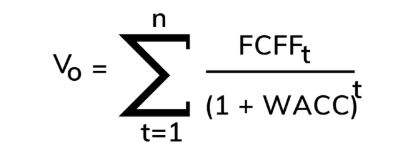
Where:
- V: Firm value (including the value attributable to creditors and owners)
- FCFF: Net cash flow of the firm
- WACC: Weighted average cost of capital of the firm (see the article on cost of capital)
- n: the number of forecast years
Case 1: The firm's net cash flow FCFF grows steadily at a rate (g). Assuming: g < WACC. The firm value is then calculated as:
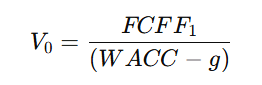
Where FCFF₁: the firm's cash flow (FCFF) after 1 year
Case 2: The firm's net cash flow FCFF grows unsteadily
Assuming: The firm's net cash flow FCFF has different growth rates across periods.
Period 1 runs from year one to year k, growing at a rate of g.
Period 2 runs from year (k + 1), growing steadily at a rate of g'. (g and g' < WACC).
The firm value (V₀) is then calculated as:

Where:
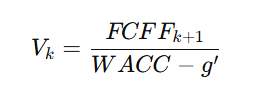
After determining the firm value (Vo), we determine the firm value attributable to owners' equity as follows:
VE=V0−VD
Where: V : The value of debts borrowed from creditors
Thus, the share price valued by the net cash flow discounting method (FCFF) is calculated as:

2. What is FCFE?
Free cash flow to equity (FCFE) is the total cash flow from business operations distributed to the owners of the business, after repaying interest and principal to creditors, paying for new investment expenditures and changes in working capital requirements.

2.1 FCFE formula
The free cash flow to equity (FCFE) discounting method has the same advantages as the FCFF method. However, this method gives more accurate results, especially for businesses that implement a low dividend payout policy.
-
Method 1
FCFE = Net income (NI) – New investment in fixed assets + Depreciation – Change in working capital + (New borrowings – Repayment of old principal)
-
Method 2
FCFE = (EBIT – Interest expense) x (1 – CIT rate) – New investment in fixed assets + Depreciation – Change in working capital +
(New borrowings – Repayment of old principal)
Equity value for owners is calculated by discounting free cash flow to equity (FCFE) at the company's cost of equity. The general formula is as follows:
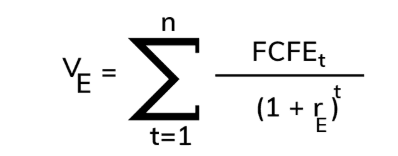
In which:
- V: Enterprise value attributable to equity
- FCFEₜ: Free cash flow to equity of the company in year t
- rₑ: Cost of equity of the company
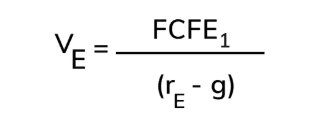
Case 1:
The company's free cash flow to equity (FCFE) grows steadily at a rate (g):
Case 2:
The company's free cash flow to equity (FCFE) grows unsteadily.
Assumption: The company's FCFE has different growth rates across periods.
- Period 1: from year one to year k, growing at a rate of g
- Period 2: from year (k + 1) onward, growing steadily at a rate of g'
- Condition: g and g' < rₑ
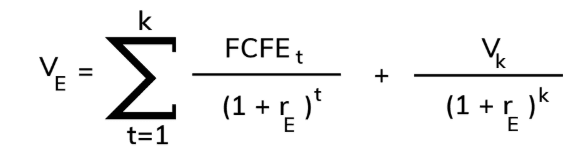
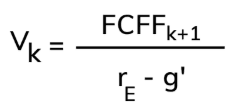
In which Vₖ is calculated as:
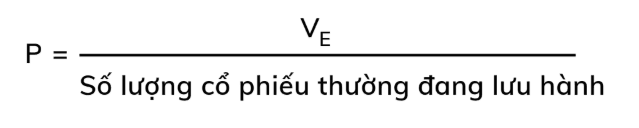
Accordingly, the share price valued by the free cash flow to equity (FCFE) discounting method is calculated as:
2.2 Limitations of the FCFE model
- Heavily dependent on forecasts
- Sensitive to changes in debt
- Prone to distortion if CAPEX is inaccurate
- Difficult to apply to cyclical companies
Conclusion
FCFE is a powerful valuation method when a company does not have a stable dividend policy. Correctly understanding the nature of the cash flows and the assumptions will help improve valuation accuracy.
We hope that the investment knowledge from Shinhan has helped investors better understand the income statement
(!) This article is for informational purposes only and is not investment advice. Readers should conduct their own research or consult an expert before making financial decisions.