
UNDERSTANDING THE TIME VALUE OF MONEY
1. Concept
The time value of money (TVM) is one of the fundamental principles of finance, and at the same time a tool that helps value an investment is:
- Equal amounts of money at different points in time will have different values.
- An amount of money at the present time will be worth more than in the future because the investor can use the present amount to invest and generate returns.
2. Why do you need to understand the time value of money?
Understanding the time value of money helps investors compare and select investments when the returns on each investment occur at different points in time in the future. From there, investors can assess and make decisions about their investments.
3. Why money has a time value
3.1. The opportunity to use money
Suppose there are 2 amounts of money (1) and (2), each worth $100. Amount (1) is received at the present time and amount (2) is received 1 year later. Amount (1) at the present time can be placed in a savings deposit at an interest rate of 7%/year. After 1 year, the value of amount (1) rises to $107 while amount (2) is worth $100. Money received earlier can be used to invest and generate more profit than money received later.
3.2. Inflation
Inflation erodes the value of money and reduces purchasing power. This means that the value of money in the future is much lower than at present.
3.3. The risk of not receiving the money
Because the future is very hard to predict and it is very difficult to know how economic and social conditions will affect an amount of money in the future. Therefore, money received at the present time is more certain than money received in the future.
4. Formula for calculating the value of cash flows
The time value of money depends on interest rates, inflation and risk. Among these, the interest rate is the main factor affecting cash flows. Future cash flows are converted to the present by
"discounting" at an interest rate. The time value of money is reflected through present value and future value.
- The value of money depends on: interest rates, inflation and risk
- Future cash flows are converted to the present by discounting
- There are 2 main concepts:
- PV (Present Value): Present value
- FV (Future Value): Future value
Formula
Future Value
FV=PV(1+r)nFV = PV(1+r)^nFV=PV(1+r)n
PVPVPV
r (%)r\,(\%)r(%)
nnn
24681012141618205001000150020002500$2,653.30
Where:
- PV: present value
- r: interest rate
- n: number of periods
Present Value
PV=FV(1+r)nPV = \frac{FV}{(1+r)^n}PV=(1+r)nFV
PVPVPV
r (%)r\,(\%)r(%)
Where:
- FV: future value
- r: interest rate
- n: number of periods
Worked examples
Example 1
- Interest rate: 10%/year
- Investment: $100 for 2 years
→ FV = 100 × (1 + 10%)² = $121
Example 2
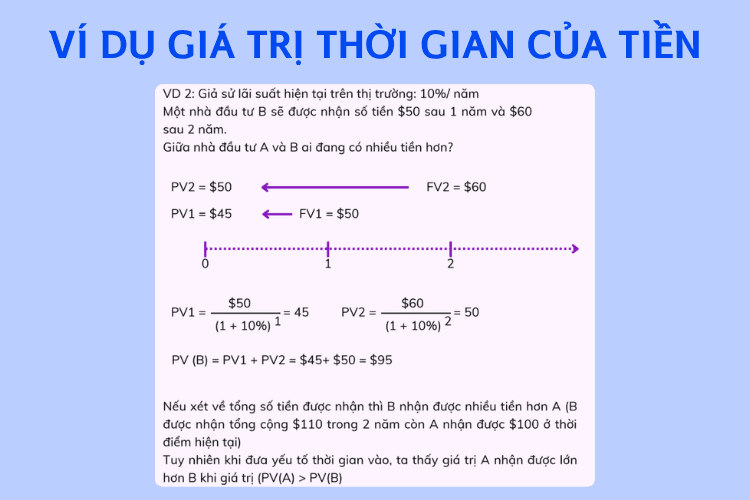
- Receive: $50 after 1 year and $60 after 2 years
- Interest rate: 10%
Calculate the present value:
- PV1 = 50 / (1 + 10%) = 45
- PV2 = 60 / (1 + 10%)² = 50
→ PV(B) = 45 + 50 = $95
Comparison:
- Total amount received: B = $110 > A = $100
- But in terms of time value:
→ PV(A) > PV(B)
We hope that this investment knowledge from Shinhan has helped investors better understand the income statement
(!) This article is for informational purposes only and is not investment advice. Readers should conduct their own research or consult a professional before making financial decisions.