
ANALYSING A COMPANY'S MANAGEMENT
Company management
A company's management comprises the Board of Management and the Board of Directors, who are the leaders responsible to shareholders and who manage, lead and set the direction for the company's business development activities.
SIZE OF THE BOARD OF DIRECTORS
In a company, the management consists of:
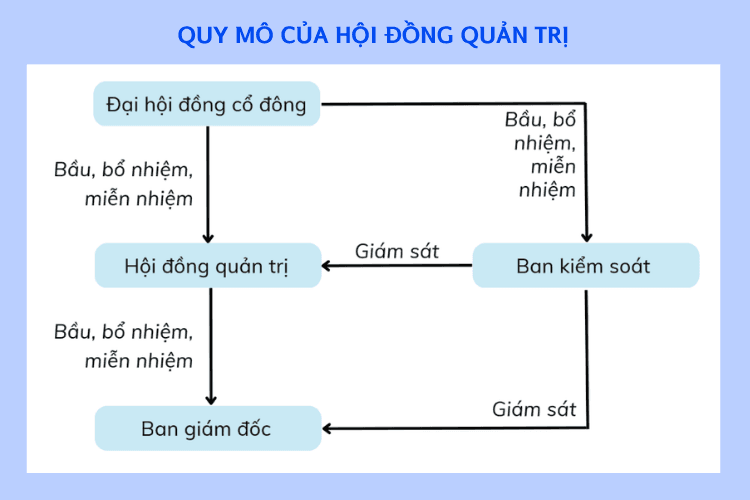
Relationships:
- The General Meeting of Shareholders elects the Board of Directors and the Supervisory Board
- The Board of Directors appoints the Board of Management
- The Supervisory Board oversees the Board of Directors and the Board of Management
Note:
- Number of Board members: from 03 to 11 people depending on the company
- Works best with around 03–08 members (avoids internal conflict, easier to control)
- More than 09 members may make control difficult and reduce operating efficiency
How many shares of the company they run does the management own?
Investors need to pay attention to the company's shareholder structure. Does the management own the majority of shares in the company they are running? Only when they hold a significant stake are the company's interests tied to their own interests, and any damage they cause to shareholders and the company is also damage they must bear.
Conversely, if the management owns few shares in the company, at least 2 problems arise: (1) the management will not give their all for the company because the benefit to them is too small, and (2) the company may be vulnerable to takeover.
Does the management trade shares with related parties or with members of the Board of Directors?
Investors need to pay attention to related-party transactions:
They can easily manipulate the stock market, set share prices and conduct undisclosed ("chui") trades through communications, "luring" short-term shareholders into buying additionally issued shares under commitments to invest in business operations, large profits and future share price increases. They then quietly sell the shares they hold in order to drive the share price sharply down and profit for themselves.
Example: the case of the undisclosed sale of FLC shares by Mr. Trinh Van Quyet: Mr. Quyet directed many people to join in "inflating the price" of FLC shares by 64% in order to make an undisclosed sale of 74.8 million shares, illicitly gaining up to 530 billion VND.
Does the management put shareholders' interests first?
Investors need to consider:
- Whether the management shifts profits to another company in which they own a larger stake
Example:
- Chairman X owns:
- 50% of company A
- 100% of company B
- Company A:
- Cost of goods: $40
- Market selling price: $100
- But A sells to B at $60
→ Profit is shifted to B (where the executive owns more) - Result:
- Company A: $20 profit
- Company B: $40 profit
Is the management honest and transparent in the company's business operations?

- The management must be honest and transparent in business operations and company matters. They are willing to disclose all financial information, frankly share the difficulties and challenges the company faces, and openly present solutions to their shareholders.
- In addition, they need to regard shareholders as partners and treat them fairly. There should be no preferential treatment for major shareholders or related members. The company must ensure fairness for all shareholders.
What growth plan and vision does the management have?

- Investors should rely on the figures in the annual report and financial statements to assess the management's direction and vision for the
future.
- Besides that, investors should also monitor whether the company completes the plans
it sets each year. Business plans that are close to actual results show that the company is good at forecasting the future. At the same time, this demonstrates the honesty of the company's management in not overstating the company's future prospects.
We hope that this investment knowledge from Shinhan has helped investors gain a clearer understanding of the business results report
(!) This article is for informational purposes only and is not investment advice. Readers should conduct their own research or consult an expert before making financial decisions.