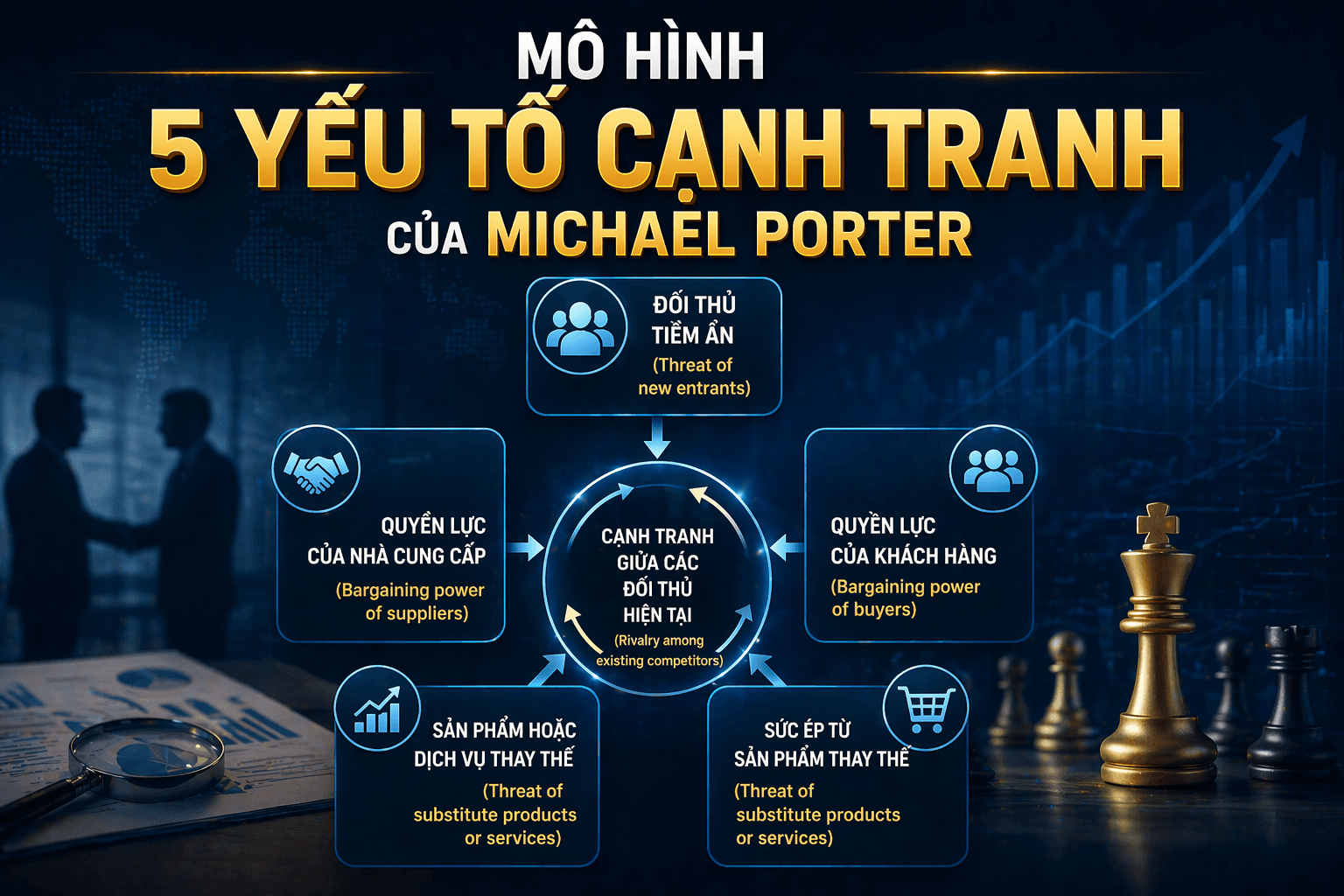
MICHAEL PORTER'S 5 COMPETITIVE FORCES MODEL
1. Concept of the 5 competitive forces model
- 5 Forces (Five Competitive Forces) are 5 competitive factors at work in the market that investors need to analyse in order to assess the degree of market impact on a business.
- Analysing these 5 factors helps businesses and investors determine the growth potential and the level of competition of an industry, thereby understanding and assessing the current position of the business and its ability to grow in the future.
2. The factors in the model
2.1. Competition within the industry
- This factor tells us about the intensity of current competition within the industry. It considers the number of existing competitors and what each competitor can do to affect the business.
- Competitive rivalry is higher when the products of companies in the same industry are less differentiated and customers prioritise price when choosing products.
When competition is high, price-cutting wars will occur, which strongly affects the profitability of the business.
2. 2. The potential of new entrants
- A company's position is also affected by the number of potential new entrants into the market. The less time and money a new entrant needs to penetrate the market in which the company operates, the more easily a company's position can be weakened.
The stronger the industry's barriers to entry, the more secure a company's position in that industry, and companies in the industry will find it easier to charge higher prices and negotiate better terms.
2. 3. The supplier factor
- The supplier factor can affect the company through increases in input costs. This affects the company's profits.
- The fewer input suppliers a business has, the fewer choices the company has in selecting suppliers and the more dependent it is on suppliers.
Suppliers will have more power and can easily raise input costs when a business has few suppliers to choose from. Conversely, when there are many suppliers or the cost of switching between suppliers is low, the company can better control input costs.
2. 4. The customer factor
- The customer factor directly affects a business through the business having to cut prices to attract customers, thereby affecting profits.
- This factor is influenced by the number of customers in the market, the importance of each customer and the cost the company must pay to find customers.
The fewer customers there are in the market and the greater the impact of each customer on the business, the more power customers have to negotiate lower prices and better deals.
2. 5. Substitute products
- Products used as substitutes for the products that companies in the industry are offering can threaten the current growth potential of businesses in the industry.
- Substitute products will affect a business's revenue, as price increases on its products may cause customers to switch to substitute products.
3. BENEFITS OF THE 5 FORCES MODEL
The 5 competitive forces model brings the following 3 basic benefits:
3. 1. Assessing the business's development strategy:
After analysing the 5 competitive forces model, investors can assess the business strategy of the company and thereby consider the company's future prospects.
3. 2. Assessing the strengths and weaknesses of the business:
The model helps investors identify the strengths and weaknesses of a business, making investment decisions easier.
3. 3. Grasping an overview of the industry the company operates in:
This model gives businesses a comprehensive view of the industry they participate in, thereby enabling more accurate investment decisions.
4. THE DIFFERENCE BETWEEN THE 5 COMPETITIVE FORCES MODEL AND SWOT
- The 5 competitive forces model and SWOT are both tools used to analyse and make strategic investment decisions.
- Companies, analysts and investors use Porter's 5 competitive forces model to analyse the competitive environment within an industry. Meanwhile, they tend to use SWOT analysis to look more deeply at a business's internal factors in order to assess that business's internal potential.
We hope that this investment knowledge from Shinhan has helped investors better understand the business results report
(!) This article is for informational purposes only and is not investment advice. Readers should do their own research or consult an expert before making financial decisions.