
1. What is a cash flow statement?
A cash flow statement is a financial statement that shows the cash received and cash paid out by a business during a business cycle.
First of all, we must understand that financial statements apply two accounting principles: accrual accounting and cash accounting.
1.1. Accrual basis
Revenue and expenses are recognised at the time they arise, regardless of the time of actual cash receipts and payments.
Applied to the Income Statement.
1.2. Cash basis
Revenue and expenses are recognised at the time cash is actually received or paid, regardless of when the transaction arises. Applied to the Cash Flow Statement.
1.3. Example
Company A sells a shipment of goods worth 100 million. The customer pays 70 million immediately and will pay the remaining 30 million later. The Income Statement will then record revenue of 100 million. The Cash Flow Statement will record 70 million.
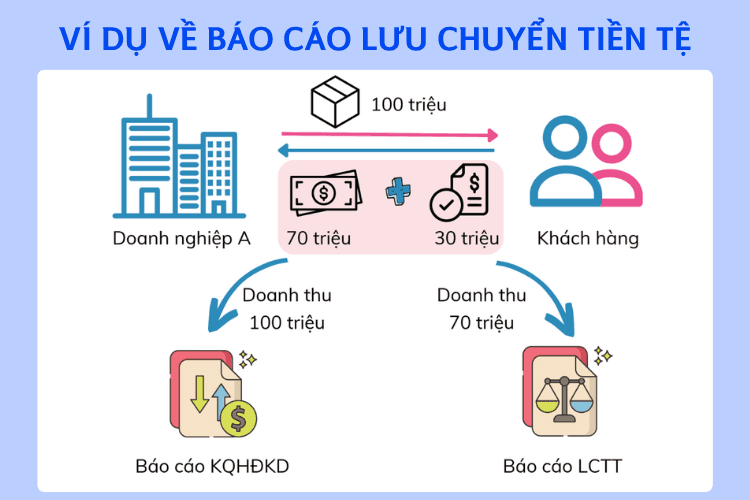
Illustration of a cash flow statement
2. Components of the cash flow statement

Illustration of the components of the cash flow statement
2.1. Cash flow from operating activities
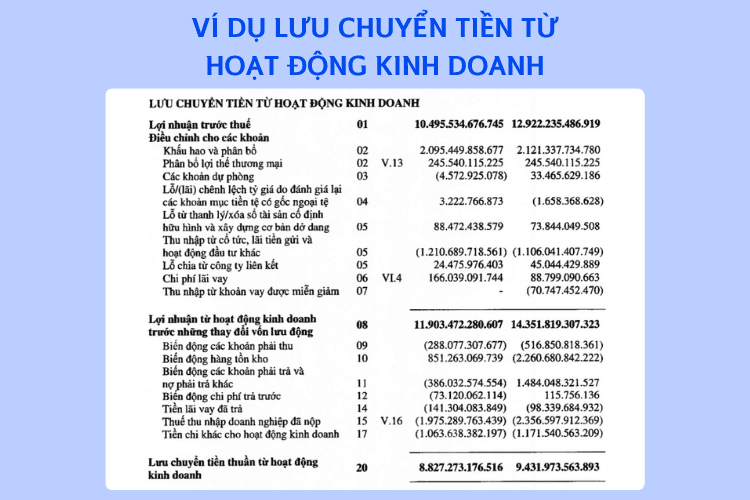
Illustration of cash flow from operating activities
This is the cash flow arising directly from the core business operations of the enterprise.
Net cash flow from operating activities is determined from profit before tax, plus/minus adjustments such as depreciation, provisions, etc. Of these, depreciation usually accounts for a large proportion.
Depreciation is the wear-and-tear expense of an asset, estimated based on the total useful life of the asset. Since depreciation is an estimated expense and does not cause the enterprise to lose cash, depreciation expense is added back when calculating cash flow from operating activities.
After these adjustments, we continue to add/subtract changes in items such as receivables, inventories, payables, etc.
Inventories: goods serving the production and business process.
An increase in inventories indicates that the company has spent cash to stockpile inventories.
A decrease in inventories indicates that the company has received cash from selling inventories.
Receivables: the amounts customers owe for products/services purchased but not yet paid to the enterprise. A decrease in receivables indicates that the enterprise has received cash from customers.
Conversely, an increase in receivables means the enterprise has not collected the cash.
Payables: the amounts the enterprise owes for goods/services purchased from suppliers but not yet paid. A decrease in payables indicates that the enterprise has spent cash to repay debts. An increase in payables indicates that the enterprise is making use of capital from its suppliers.
2.2. Cash flow from investing activities
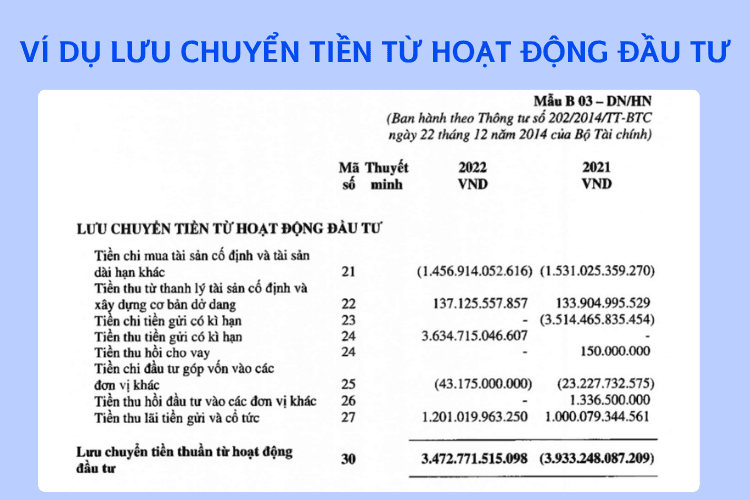
Illustration of cash flow from investing activities
This is the cash flow comprising asset investment expenditures such as: upgrading and maintaining fixed assets (production plants or equipment, etc.) and cash received from: liquidating fixed assets and the enterprise's investments.
Cash flow from investing activities helps investors see the enterprise's investment activities as well as its asset disposals.
Capital expenditure: Capital expenditure is the investment cost to purchase, upgrade and maintain fixed assets (industrial buildings or equipment, etc.)
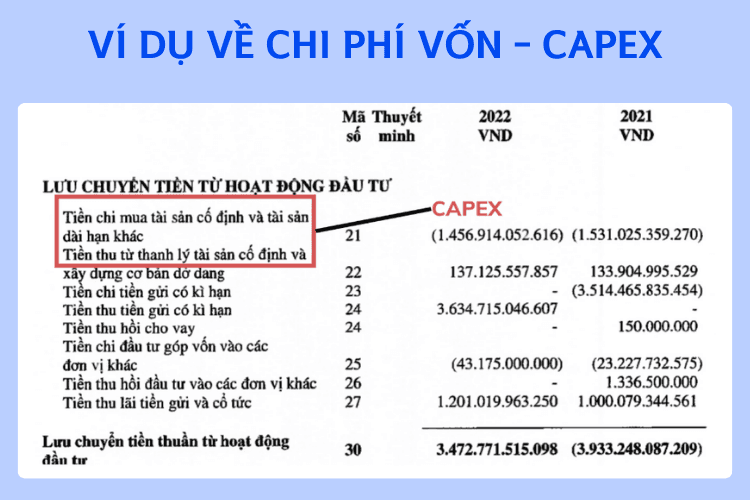
Illustration of capital expenditure - CAPEX
Example: The enterprise's Capex in the above statement for 2022 was 1,319 million VND (1,456 million VND - 137 million VND).
2.3. Cash flow from financing activities
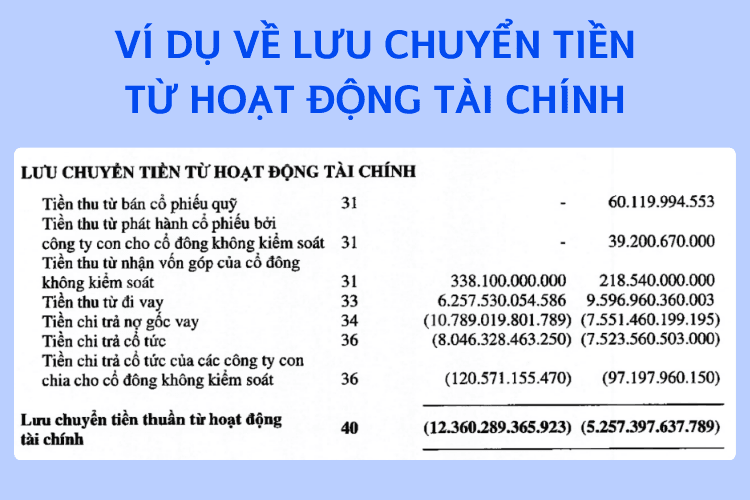
Illustration of cash flow from financing activities
This is the cash flow related to the enterprise's capital sources, including:
- Cash flow from owner's equity: Cash received/paid from issuing/repurchasing shares and paying dividends.
- Cash flow from borrowings: Cash received/paid from borrowing/repaying debts.
Net cash flow during the year is calculated by taking the total cash flows from operating activities, investing activities and financing activities
| Cash and cash equivalents at the end of the year = Net cash flow during the year + Cash and cash equivalents at the beginning of the year + Effects of exchange rate changes |
3. Points to note when reading a cash flow statement
3.1. Negative net cash flow from operating activities
Negative net cash flow from operating activities indicates that the enterprise has not collected cash from its business operations, and that its cash balance has even been reduced.
However, not every case is a cause for concern. Sometimes, during an expansion phase, an enterprise has to import more goods or boost sales through buy-now-pay-later policies (which increases receivables), leading to negative operating cash flow. On the other hand, if this situation persists, it is an alarm signal. The enterprise will then have to supplement cash for its operations by taking on more debt or liquidating some assets and investments.
3.2. Cash flow from operating activities does not cover capital expenditures
Cash flow from operating activities that is lower than capital expenditures shows that the business is not generating enough cash for expansion investments. At this point, the business will have to finance those investments by borrowing or raising capital. This shows that the business is less proactive in investing for development as it has to depend on external funding sources.
3.3. Capital expenditures (Capex) lower than depreciation expenses
A business's Capex being lower than its depreciation expenses shows that the volume of additional invested assets is lower than the level of wear and tear of total assets. This is a sign that the company is downsizing.
3.4. Declining dividends or no dividend payments
Eliminating dividends or reducing dividends is one of the policies a business applies when it needs additional cash. This can occur when business results are weak or when the business needs cash to step up its investment activities.
However, this situation occurring continuously for many years is alarming.
We hope the investment knowledge from Shinhan Securities Vietnam (SSV) has helped investors better understand the income statement.
(!) This article is for informational purposes only and does not constitute investment advice. Readers should conduct their own research or consult an expert before making financial decisions.