How do you know whether a business is financially strong or weak? The balance sheet is the tool that lets investors see this clearly by analysing assets, liabilities and equity at a specific point in time.
1. Quick summary
(1) Reflects the financial position at a point in time
(2) Comprises 3 parts: assets, liabilities, owners' equity
(3) Core principle: Assets = Liabilities + Equity
(4) Helps assess solvency and risk levels
(5) An important foundation in stock analysis
2. What is a balance sheet?
The balance sheet is a financial statement that presents all the assets a business owns and the sources of capital that formed those assets.
Put simply:
I. What the business has → Assets
II. Whether the business borrows or funds itself → Sources of capital
3. Structure of the balance sheet
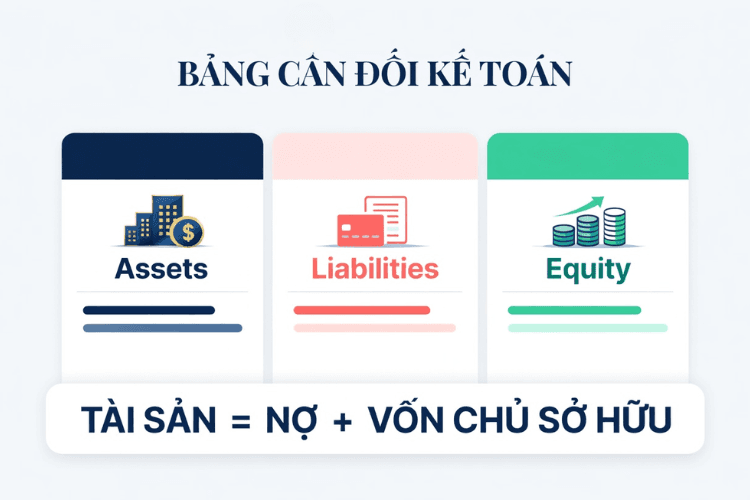
The balance sheet consists of 2 main parts:
3.1. Assets
Reflects all the resources the business owns.
Including:
a. Short-term assets
- Cash
- Inventory
- Receivables
b. Long-term assets
- Factories
- Machinery
- Long-term investments
Shows the scale and revenue-generating capacity.
3.2. Sources of capital
Liabilities
(1) Short-term liabilities
(2) Long-term liabilities
Indicates the level of financial leverage used.
Owners' equity
i. Contributed capital
ii. Retained earnings
Reflects the business's level of financial self-sufficiency.
4. How to identify and apply
When reading a balance sheet, focus on:
(1) Compare assets and liabilities
Is the business borrowing too much
(2) Look at the asset structure
Do short-term or long-term assets dominate
(3) Track owners' equity
Is it growing steadily or not
(4) Compare with the industry
Where does the business stand
5. Illustrative example
A business with:
- Steadily increasing assets
- Low debt
- Rising owners' equity
Is usually a business with a sound financial foundation.
Conversely:
- Debt rising quickly
- Equity declining
May be a sign of risk.
6. Common mistakes
(1) Only looking at total assets without examining their quality
(2) Not comparing with businesses in the same industry
(3) Assessing based on a single reporting period
(4) Overlooking the relationship between debt and cash flow
Conclusion
The balance sheet helps investors clearly understand a business's financial structure and level of safety before making a decision.
(!) This article is for informational purposes only and is not investment advice. Readers should conduct their own research or consult a professional before making financial decisions.