This article compiles some basic knowledge and notes on how to invest in securities that any investor must master so that the securities trading process goes as smoothly as possible.
Securities trading hours
Securities trading hours (also known as the stock market opening hours) differ from one stock exchange to another. Therefore, investors need to clearly grasp these time frames in order to promptly understand how to invest in securities and capture useful information. Having a clear grasp of securities trading hours helps investors close more orders at better prices.
Conversely, if you place securities transactions outside operating hours, you risk encountering delays. This may make it difficult to closely follow changes and fluctuations in market prices, creating unpredictable risks.
| Session | Trading method | Trading hours |
| Morning | Continuous order matching | 9h 00 - 11h 30 |
| Put-through transactions | 9h 00 - 11h 30 | |
| Lunch break | 11h 30 - 13h 00 | |
| Afternoon | Continuous order matching | 13h 00 - 14h 30 |
| Periodic closing call auction | 14h 30 - 14h 45 | |
| Put-through transactions | 13h 00 - 15h 00 | |
| After-hours order matching | 14h 45 - 15h 00 | |
Vietnam securities trading hours
There are 3 main exchanges on the Vietnamese stock market, comprising HOSE, HNX and UPCoM, which only trade on business days and do not trade on public holidays.
| Exchange | HOSE | HNX | UPCoM | |||
| Time | Trading method | Orders used | Trading method | Orders used | Trading method | Orders used |
| 9h00 - 9h15 | Periodic opening call auction | ATO, LO Order amendment/cancellation not allowed | Continuous order matching I | LO, MTL, MOK, MAK Order cancellation/amendment allowed | Continuous order matching I | LO Order cancellation/amendment allowed |
| 9h15 - 11h30 | Continuous order matching I | LO, MP Order amendment/cancellation allowed | ||||
| 11h30 - 13h00 | Mid-session break | |||||
| 13h00 - 14h30 | Continuous order matching II | LO, MP Order amendment/cancellation allowed | Continuous order matching II | LO, MTL, MOK, MAK Order cancellation/amendment allowed | Continuous order matching II | LO Order cancellation/amendment allowed |
| 14h30 - 14h45 | Periodic closing call auction | ATC, LO Order amendment/cancellation not allowed | Periodic closing call auction | ATC, LO Order cancellation/amendment not allowed | ||
| 14h45 - 15h00 | After-hours order matching | PLO Order cancellation/amendment not allowed | ||||
| 9h00 - 11h30 & 13h00 - 15h00 | Put-through transactions (**) | Put-through orders | Put-through order matching | Put-through orders | Put-through order matching | Put-through orders |
Reading the Shinhan Securities Vietnam (SSV) price board
To supplement information on basic how to invest in securities, investors need to start learning by heart how to view and read the electronic securities trading board in the most accurate way.
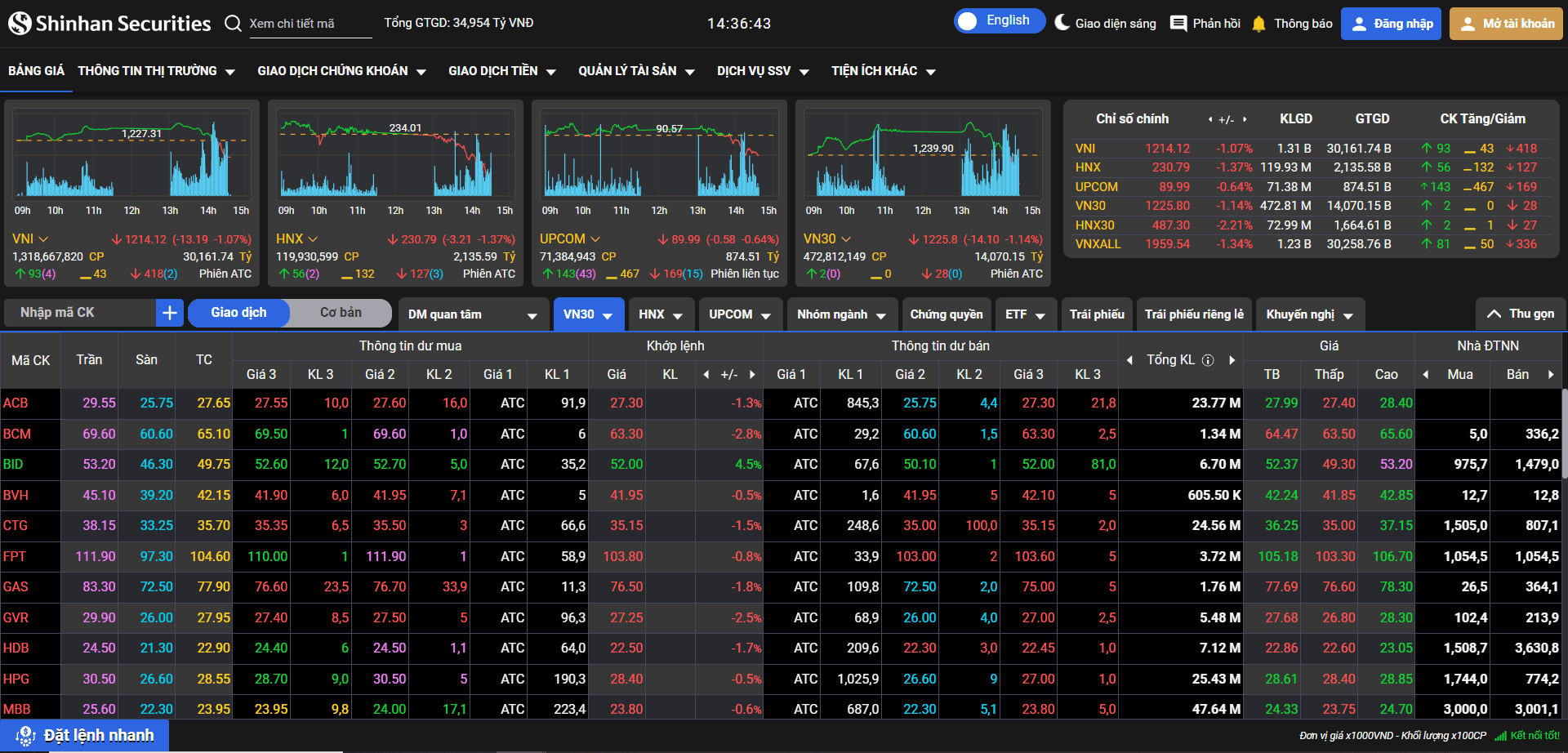
Shinhan Securities Vietnam (SSV) electronic price board
-
The “mã CK” (securities code) column: Each code corresponds to one type of stock; it is the list of securities codes being traded, and when you click on each code you can view the chart or place a buy/sell order for that stock
-
The “Trần” (ceiling, purple), “sàn” (floor, blue) and “TC” (reference, yellow) price columns: These are the possible prices that may occur during the trading session. More simply, the price can only fluctuate within that range, with the maximum in purple, the minimum in blue, and yellow meaning unchanged from the previous session.
-
The “Thông tin dư mua” (bid information) column: Shows expectations for the bid price and the corresponding buy volume of that stock. In addition, we can refer to the 3 most recent buyer prices corresponding to the columns “Giá 3 - KL3, Giá 2 – KL2, Giá 1 - KL1".
-
The "Sell order information" column: Similar to the buy side column, the sell side column reflects the price expectations of sellers for that stock. We can refer to the 3 nearest prices of sellers corresponding to the "Price 1 – Vol 1, Price 2 – Vol 2, Price 3 – Vol 3" columns.
-
The "Matched order" column: Shows the price and volume of orders matched in buy or sell transactions and the % price increase/decrease within the session. The principle of the matched order column is that buy prices are matched from high to low and sell prices are matched from low to high, and orders will be matched according to each trading session.
-
The "Total Vol" column (Total volume): The total volume of shares traded during the session
-
The "Avg", "Low", "High" price columns: show the average price, highest price and lowest price matched during the session.
-
The "Foreign investors" column: The Foreign investors column is the column showing capital flows from abroad, the buy and sell volumes of foreign investors.
To stay regularly updated on market news, new investors may consider referring to recommendation lists, following the electronic securities board and reading financial analysis reports right on the price board to analyse the market. You need to grasp the situation of enterprises and the market; this will be one of the ways to invest in securities, and is also a factor for investors to make judgements and adjust their own investment strategies to suit the actual situation.
Points to note when buying/selling securities
Do not be in too much of a hurry
New investors often make this mistake when starting to invest in securities; do not let the market deceive you, learn the basic ways to invest in securities starting with the first important thing in smart investing, which is prudence and patience. In addition, you can read more securities books to broaden your own stock of knowledge.
Follow the market regularly
Before placing a buy – sell order for shares, regularly following and observing the market will help investors gain a deeper view of the target market. In addition, basic securities investment knowledge such as analysing the market through financial statements or technical analysis also provides useful information that helps you easily orient your investments, from which it is easy to identify the suitable type of shares in order to decide whether to continue investing or to sell/buy.
Compare return – risk
Comparing return and risk in securities investment will help investors select shares with great potential. From there, investors can make a judgement on whether to buy or sell.
In addition, new investors may also refer to the types of fees when investing in securities at Shinhan Securities, such as:
-
Account opening fee is free
-
Fee for transferring money out of SSV is currently free
-
Fee for direct consultation with an SSV consultant is free
-
When trading, there is a transaction fee of 0.15%; for sell transactions, an additional tax fee of 0.1% arises
Common difficulties encountered when investing in securities
Being affected by many factors, securities investment always carries potential risks. Those risks are usually expressed as follows:

Difficulties that investors often encounter in the securities market
Dependence on the economy and society
Securities are governed quite considerably by the economy and society; when an enterprise on the market experiences financial fluctuations, only stabilising the economy can help increase the money supply flowing into shares, thereby boosting growth in value.
Holding bad shares
Selling shares is much more difficult than buying shares, especially when shares fall sharply and investors do not dare to sell out. Sometimes poor shares also have a chance to recover, possibly over a long period, but holding a share based only on hope usually causes you to lose more...
Enterprise operation risk
Enterprises with steady growth in revenue and profit, and a stable borrowing and capital utilisation situation, will provide the premise for share growth. Investors can benefit from dividends distributed from the enterprise's annual retained earnings.
However, an enterprise that operates at a loss, has bad debts with banks, and uses capital ineffectively will cause the share price to fall. In addition, investors will find it difficult to receive benefits such as steady dividends each year.
Market risk
The securities market in general has the participation of many actors including regulators (the Securities Commission, the Exchanges), service providers (securities companies), and investors (individual investors, institutional investors, foreign investors). Therefore, each impact from each of these actors can cause fluctuations in the securities market.
Shinhan Securities hopes this article can help securities investors gain more knowledge about how to invest in securities, securities investment experience. SSV is a leading securities company of Korea; to gain a deeper understanding of the Vietnamese stock market, we continuously improve every day, provide professional services and always update securities information in the fastest and most accurate manner.
Do you need to open a securities account? Do you want to know more about how to invest in securities? Do not hesitate to leave a message for SSV, the customer service department of Shinhan Securities Vietnam (SSV) will contact you as soon as possible.