
You are a new investor — do you already know how to read and fully understand the Stock Price Board? If not, read the article below to enhance your investment knowledge and skills by exploring the online Price Board of Shinhan Securities Vietnam (SSV) !
What is a stock trading board?
The stock trading board is where all information related to prices and stock transactions of the stock market is displayed. When investors buy or sell stocks on the exchanges, they must all operate on the stock price board being displayed. Therefore, mastering every detail of the stock trading board will help investors maximize their opportunities when making decisions.
Stock trading price boards in Vietnam
Currently, Vietnam has 2 official Stock Exchanges: HNX (Hanoi Stock Exchange) and HOSE (Ho Chi Minh City Stock Exchange). Each Stock Exchange has its own price board, and securities companies also have their own price board to serve their customers (data is sourced from the 2 Stock Exchanges and the Securities Depository Center). These price boards differ only in terms of interface, but are basically completely identical.
In addition, the stock market also has the UPCOM (Unlisted Public Company Market) exchange, which is a "transit" trading floor established with the purpose of encouraging unlisted companies to participate in the stock market.
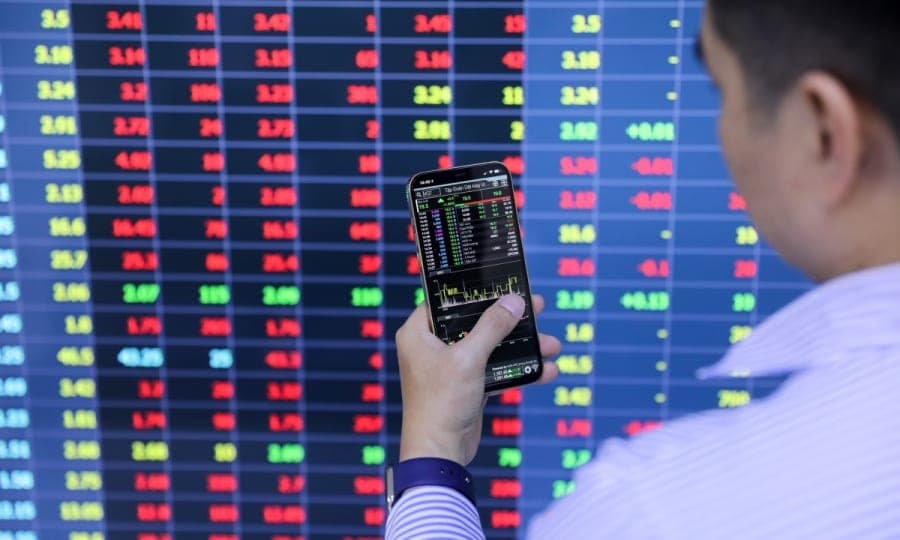
Stock trading price boards in Vietnam
Terminology and symbols on the stock price board
To supplement basic information on stock investment, investors need to start learning how to view and read the electronic stock board in the most accurate way.
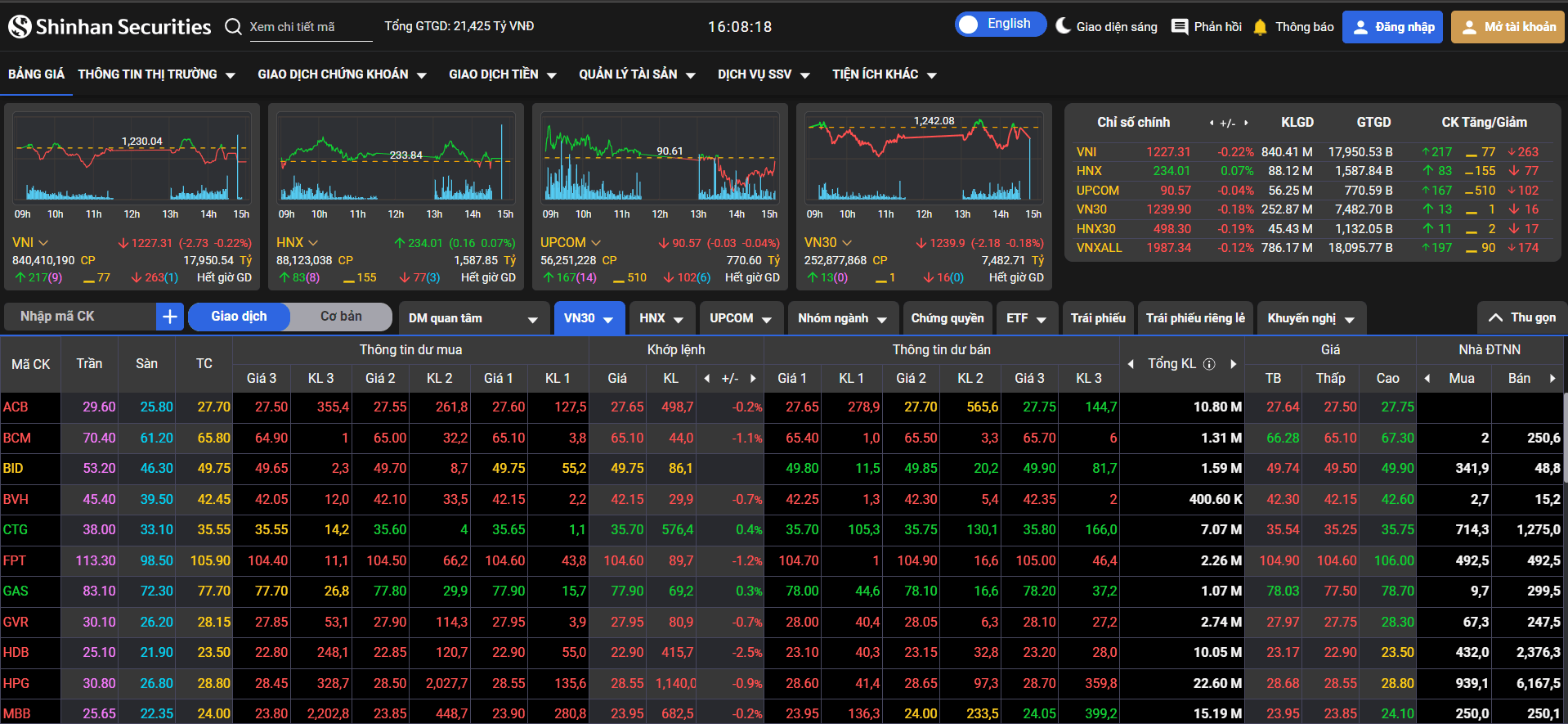
Shinhan Securities Vietnam (SSV) stock trading price board
Meaning of the column names on the stock price board
-
"Mã CK" (ticker symbol) column: Each symbol corresponds to a type of stock, the list of traded ticker symbols, and when you click on each symbol you can view the chart or place a buy/sell order for that stock.
-
"Trần" (ceiling, purple), "sàn" (floor, blue), "TC" (reference, yellow) price columns: These are the possible prices that may occur during the trading session. More simply, the price can only fluctuate within that range, with the maximum in purple, the minimum in blue, and yellow meaning unchanged from the previous session.
-
"Thông tin dư mua" (bid information) column: Shows the expectation for the bid price and the corresponding bid volume of that stock. In addition, we can refer to the 3 nearest buyer prices corresponding to the columns "Giá 3 - KL3, Giá 2 - KL2, Giá 1 - KL1" (Price 3 - Volume 3, Price 2 - Volume 2, Price 1 - Volume 1).
-
"Thông tin dư bán" (ask information) column: Similar to the buy-side column, the sell-side column shows the seller's price expectation for that stock. We can refer to the 3 nearest seller prices corresponding to the columns "Giá 1 - KL1, Giá 2 - KL2, Giá 3 - KL3" (Price 1 - Volume 1, Price 2 - Volume 2, Price 3 - Volume 3).
-
"Khớp lệnh" (matched orders) column: Shows the price and volume of orders matched in buy or sell transactions and the % price increase/decrease during the session. The principle of the matched orders column is that buy prices are matched from high to low and sell prices are matched from low to high, and orders are matched by each trading session.
-
"Tổng KL" (total volume) column: Total volume of shares traded during the session.
-
"TB", "Thấp", "Cao" price columns: show the average price, highest price, and lowest price matched during the session.
-
"Nhà ĐTNN" (foreign investors) column: The foreign investors column shows the capital flow from abroad, the buy and sell volumes of foreign investors.
Color conventions on the stock price board
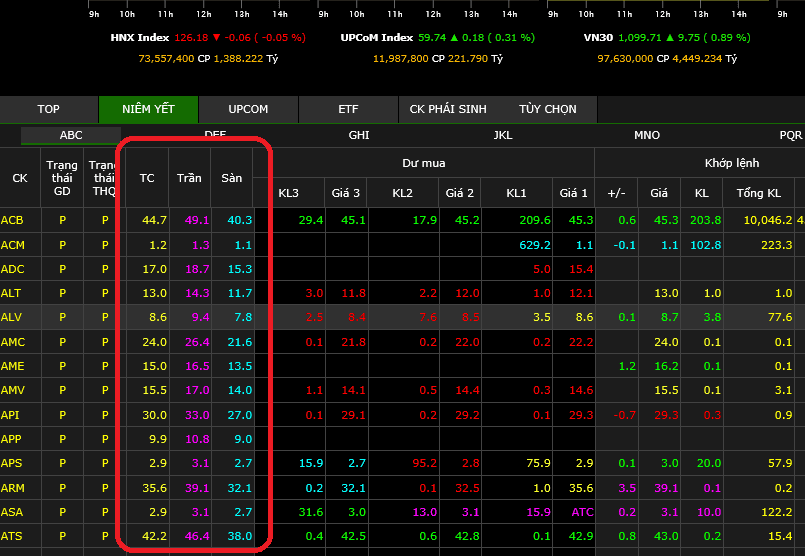
Each color has a different meaning on the stock trading board
-
Purple: The price is rising to the ceiling compared to the reference price (which is yesterday's closing price) of the corresponding ticker symbol. For stocks on the HOSE exchange this is an increase of 7%, and for stocks on the HNX or Upcom exchange it is an increase of 15%.
-
Green: The price is rising compared to the reference price of the ticker symbol but has not reached the ceiling.
-
Yellow: The price is equal to and unchanged from the reference price of the corresponding ticker symbol.
-
Red: The price is falling compared to the reference price of the corresponding ticker symbol.
-
Blue: The price is falling and has hit the floor compared to the reference price of the corresponding ticker symbol. For stocks on the HOSE exchange this is a decrease of 7%, and for stocks on the HNX or Upcom exchange it is a decrease of 15%.
Types of orders on the market
LO order (Limit Order): an order to buy/sell securities at a specified price (with a specific price stated).
ATO/ATC order (At The Open/At The Close): an order to buy or sell regardless of price in the periodic opening or closing session.
MP order (Market Price Order): an order to buy/sell securities at the lowest selling price/highest buying price currently available on the market.
MTL/MOK/MAK orders (Market To Limit/Match Or Kill/Match And Kill – Market-to-limit order/ Market order to match all or kill/ Market order to match and kill): these are the types of continuous matching orders on HNX.
PLO order (Post Limit Order): is an order matched after the closing periodic order matching session on the HNX exchange.
However, for new investors, we only need to know 4 basic order types: LO, ATO/ATC, MP
Market indices
-
VN-Index: An index reflecting the price movement trend of all stocks listed and traded on the Ho Chi Minh City Stock Exchange (HOSE).
-
VN30-Index: A price index of the 30 bluechip stocks on the market.
-
VNX-AllShare: A general index reflecting the movement of all stock prices listed on HOSE and HNX.
-
HNX-Index: An index calculated based on the price movements of all stocks listed and traded on the Hanoi Stock Exchange (HNX).
-
UPCOM-Index: An index calculated based on the price movements of all stocks traded on the UPCoM market, which belongs to HNX.
Shinhan Securities Vietnam (SSV) electronic stock trading price board
Shinhan Securities Vietnam (SSV) has comprehensively upgraded its securities trading system, including the online stock trading board. Now investors can conveniently monitor the electronic stock board as well as the corporate financial indicators of the stock tickers they are interested in. In addition, investors can place buy and sell orders right on the price board and view the recommendation list as well as read recommendation reports integrated right on the electronic stock board of Shinhan Securities Vietnam (SSV)
The above is information on How to read the electronic stock board the "standard" way for newcomers when you intend to learn stock investing and build up your knowledge. Shinhan Securities Vietnam (SSV) is a leading securities trading company in Vietnam; we provide comprehensive securities services for investors. If you have questions or would like more information about SSV, please leave us a message or call our hotline right away, and our consultants will respond to you as soon as possible!