
Quick summary
- Market infrastructure: the KRX technology system has been in operation since 05/05/2025, boosting processing capacity and paving the way for new features — a favourable time for newcomers to start the right way.
- Starting principles: choose a reputable securities company, a stable platform, transparent costs, and integrated learning and analysis tools.
- Platform suggestion: Shinhan Securities Vietnam (SSV) with the San Xin Ha app, the “Chọn Shinhan, Trọn đời không phí” (Choose Shinhan, Lifetime fee-free) programme, a 0% margin lending interest rate for the first 60 days offer, preferential interest rates thereafter, together with the S‑Era AI securities assistant and direct trading connectivity on FireAnt.
1) Why is 2025 the right time for newcomers?
On 05/05/2025, Vietnam's stock market officially went live with the KRX technology system. This upgrade improves order matching capacity, harmonises regulations and creates the technical foundation for subsequent enhancements (for example: data standardisation, clearing and settlement processes).
2) A 7-step roadmap to stock investing for newcomers
Step 1. Define your goals & risk appetite
- Goals: long-term capital growth, periodic accumulation, or cash flow generation (dividends, bond coupons).
- Time horizon: short-term (< 1 year), medium-term (1-3 years), long-term (> 3 years).
- Suggested risk limits for newcomers: a maximum of 1-2%/order and 5-10%/month across the entire portfolio.
Step 2. Choose a securities company & trading platform
Core criteria: system stability (especially during the KRX period), order placement speed, portfolio synchronisation capability, a transparent fee schedule, integrated learning and analysis tools (for example: stock screeners, charts, reports), professional customer service, and convenient deposits/withdrawals.
A leading example - Shinhan Securities Vietnam (SSV):
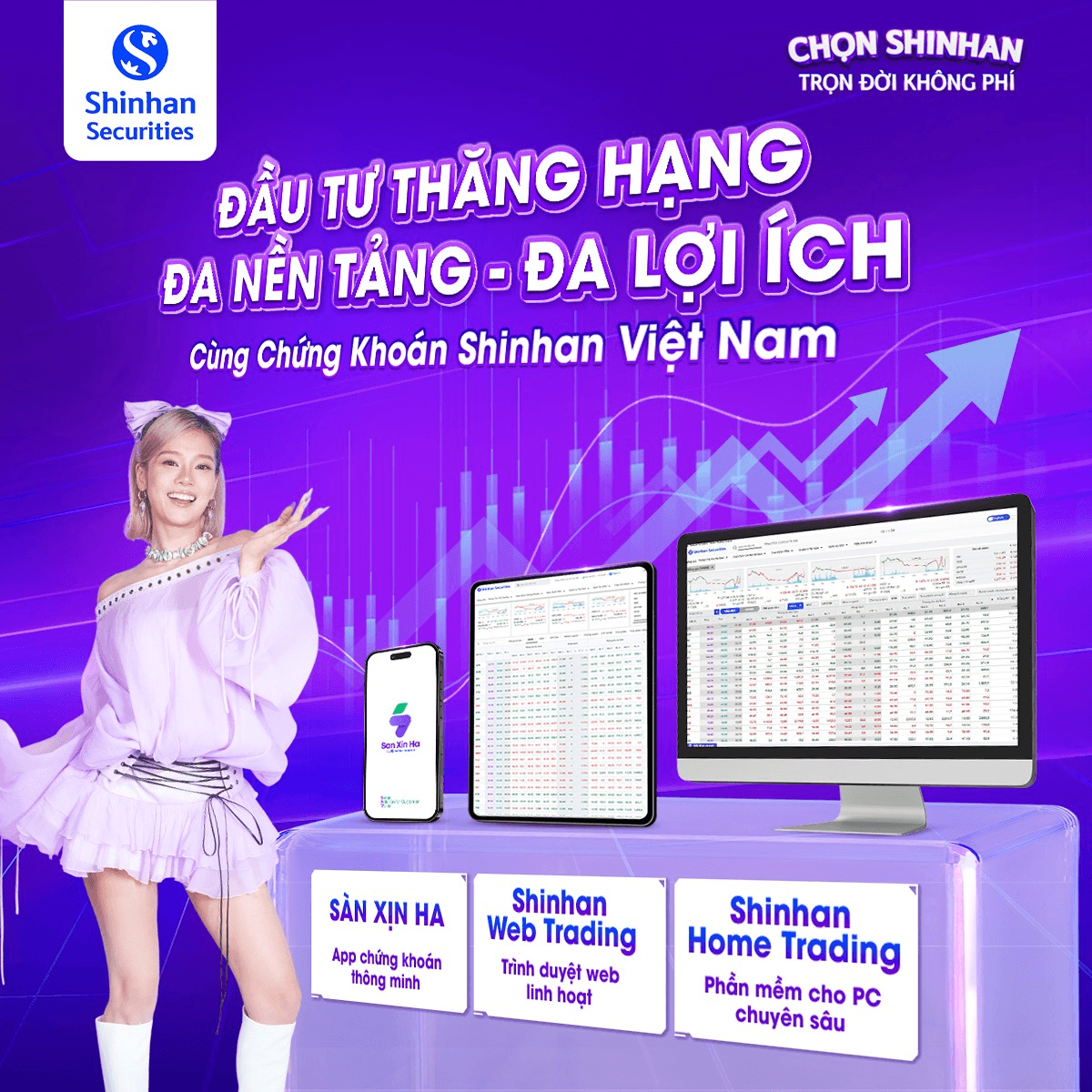
Smart stock investing on SSV's platforms
- The “San Xin Ha” trading app: a user-friendly interface, multi-platform (Mobile/Web/Home), focused on a smooth experience.
- Long-term offers: “Chọn Shinhan, Trọn đời không phí” (Choose Shinhan, Lifetime fee-free) (0% online trading fee, subject to terms and conditions); 0% margin lending interest rate for the first 60 days, followed by preferential interest rates for the subsequent period; a number of gift programmes by period.
- FireAnt connectivity: open an account and trade directly on FireAnt - seamless from analysis to order placement.
- S‑Era AI securities assistant: news updates, report summaries, technical and fundamental analysis right on the web/app.
Step 3. Open a securities account (online eKYC)
- Download the San Xin Ha app → enter your phone number and receive an OTP.
- Photograph both sides of your citizen ID card and complete facial verification (eKYC).
- Check your information and sign the electronic contract right on the app.
- Link a bank account for deposits/withdrawals; customers using the Shinhan ecosystem may enjoy additional benefits under the programme.
Quick links: Open a securities account easily at SSV | Learn about the San Xin Ha app
Step 4. Deposit funds & set up a “tuition fund”
- Capital allocation: 70% without leverage (fundamental stocks/open-ended funds/ETFs), 30% for small-scale experimentation.
- Set aside 2-3% of total capital as a “tuition fund” to test strategies without affecting your personal finances.
Step 5. Choose a strategy suited to newcomers

Four basic stock investment strategies for newcomers
- DCA (dollar-cost averaging over time): invest regularly into ETFs/open-ended funds or fundamental stocks, reducing the risk of mistiming the market.
- Core-Satellite: a core portion of 70-80% (ETFs/index funds + large-cap stocks), and a satellite portion of 20-30% (growth stocks).
- Trend-following/momentum: apply a stop-loss of 7-10% and take profit at a reward:risk ratio ≥ 1:2.
- Leverage (margin): only consider this once you have discipline and a clear trading system.
Step 6. Screen & select stocks/funds
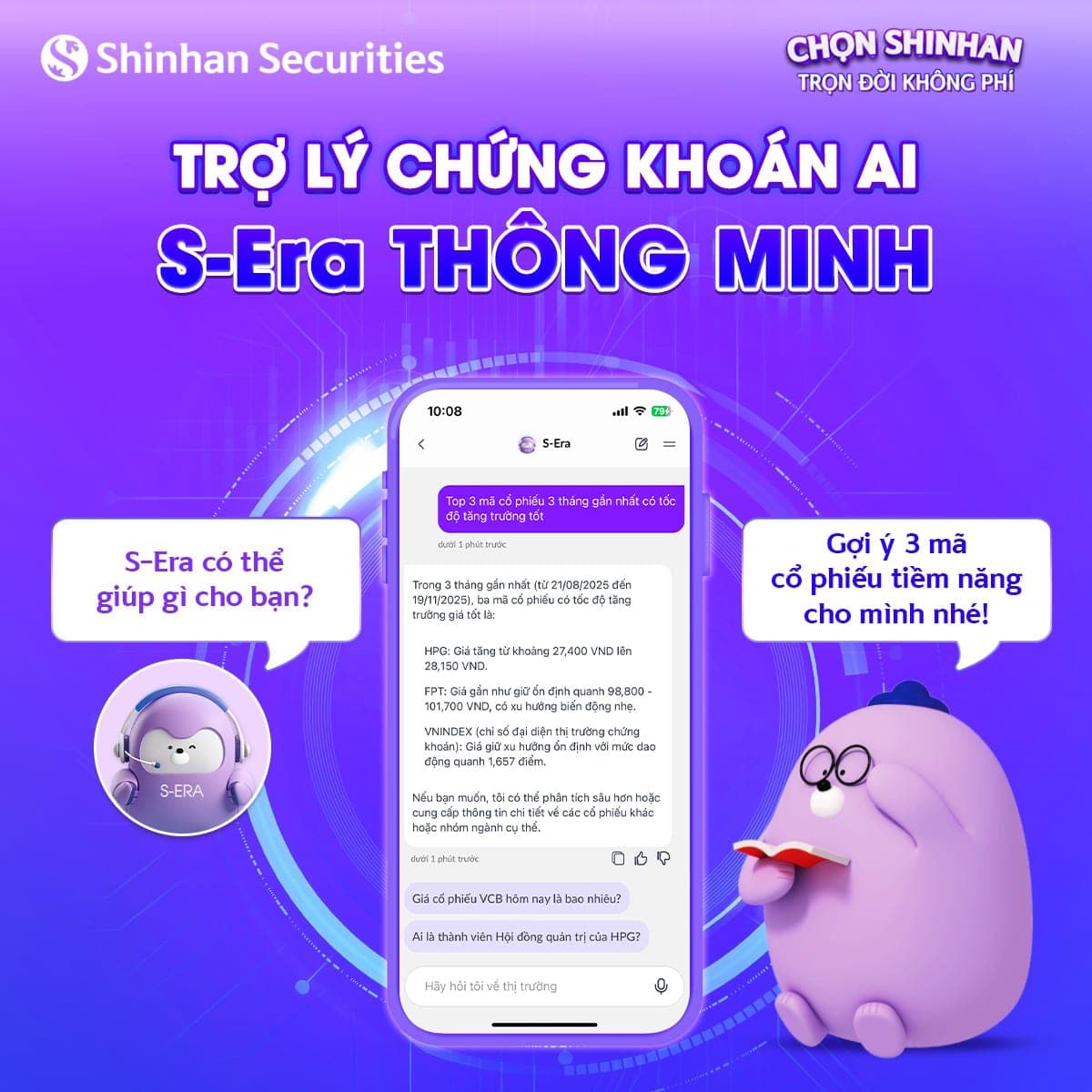
S-ERA AI can help you stay better updated on stock information
- Fundamentals: revenue/profit growth, solid ROE, a healthy debt structure, positive cash flow.
- Valuation: compare P/E and P/B against the industry and historical levels; newcomers should have a margin of safety ≥ 20% relative to the estimated fair value.
- Technicals: prioritise clear trends using the 20/50 Moving Average (MA); buy on a breakout from an accumulation zone with confirming volume.
- ETFs/open-ended funds: focus on low management fees, liquidity and a transparent reference index.
Step 7. Place orders, monitor & stay disciplined
- Draw up an order plan before the session: price - volume - stop-loss - take-profit.
- Keep a trading journal: reasons for entry/exit, emotions, results; review weekly/monthly.
- Rebalance your portfolio when weightings deviate by > 5-10%; monitor Max Drawdown to control risk.
3) Reference portfolios by capital level (not a recommendation)
Below are structural suggestions to help you build discipline and risk management habits.
Capital of 10-20 million
- 60%: ETFs/funds tracking the VN30/VN100 index - DCA on a monthly basis.
- 30%: 2-3 large-cap stocks with solid fundamentals.
- 10%: tuition fund - test strategies without using margin.
Capital of about 100 million
- 50%: ETFs/funds + fundamentally sound stocks (bluechips).
- 30%: growth stocks in accumulation/breakout zones (2-3 tickers).
- 20%: cash reserve + tuition fund; use light margin only once you have discipline.
Capital from 500 million
- 40%: fundamentally sound stocks with steady dividends.
- 40%: thematic ETFs/funds (sector/ESG/fixed income).
- 20%: growth/cyclical stocks - with tight risk control.
4) Basic mistakes to avoid
- Buying out of FOMO, without predetermining stop-loss/take-profit points.
- Using leverage too early, before having a trading system.
- Concentrating on 1-2 tickers, lacking diversification.
- Watching only the price board while ignoring financial statements and corporate news.
- Not keeping a journal, leading to repeated mistakes.
- Overlooking costs (trading fees, margin interest) when calculating net profit.
5) Frequently asked questions (FAQ)
Is opening an account complicated?
No. SSV supports 100% online account opening on San Xin Ha: download the app → OTP → take a photo of your citizen ID → eKYC → sign the electronic contract.
What offers are currently available?
The "Choose Shinhan, Lifetime Zero Fees" policy (0% online trading fee subject to conditions); 0% margin interest for the first 60 days and a preferential rate of 6.8% for the next 120 days; a number of gift programmes and flexible offers from time to time. Please see the detailed conditions and validity periods on the official website.
Are there tools to support learning and analysis?
Yes. SSV integrates the S‑Era AI assistant (through flexible Q&A in text and real-time charts, allowing users to receive market information feedback quickly; market analysis & trend forecasting, in-depth stock analysis, technical analysis & fundamental valuation; smart news feedback and summaries). It integrates 2 modes: basic & advanced - supporting smart investing, suitable for every investor. And direct trading linkage on the FireAnt application.
6) Open a securities account easily & enjoy SSV offers
- Account opening link: Open a securities account easily at SSV
- Learn about the app: San Xin Ha
- Promotions page: Promotion Programmes - Events
Checklist before your first session
- Define your investment objective and time horizon.
- Open an account and complete eKYC; link your bank, deposit a small amount to get familiar.
- Select 3-5 core tickers/ETFs; do not use margin when starting out.
- Set a 7-10% stop-loss and take profit at a reward:risk ratio ≥ 1:2.
- Create a trading journal template and stick to your discipline.
This article is for educational purposes and is not a buy/sell recommendation. Offers are subject to conditions and time limits; please check the latest information on SSV's official website.